Search for a topic

Showing posts with label chinese medicine. Show all posts

Thursday, March 10, 2016

Three Ways Acupuncture Can Help You

When you're considering whether or not acupuncture is right for you, the answer to the question "How can acupuncture help me?" is vital.

The first thing I suggest is a free private consultation. If you talk to me directly, I can outline a treatment plan that is right for you. Your consultation might be completely different than if I talked to your friend, your spouse or another family member. The reason for this is that people seek acupuncture treatment for different reasons.

1. Symptom Relief - Many people just want relief from their symptoms. If the body is a garden, symptoms are burgeoning weeds that choke its natural beauty. Acupuncture and Chinese herbs cut back the weeds. I pride myself on my ability to relieve symptoms; for many of us, a good quality of life is about stopping pain and creating a sense of ease.

Here in the US, we tend to view the body as a machine that is often
hacked by a foreign enemy known as disease. Chinese medicine
focuses on the body as a garden that can be cultivated to heal itself.

2. Corrective Care - Corrective care is my specialty; it focuses on removing the cause of your symptoms. Underneath most pain is inflammation. Weight gain is a symptom of a metabolic disorder. Addictions are a combination of neurological and emotional imbalance. We could work on symptoms forever, but to provide long-lasting relief and freedom, corrective care is necessary.


3. Preventive Care - I have clients who attribute their continuing health to their investment in acupuncture. Assisting the immune system can prevent illnesses in the future. Balancing your health early will promote your well-being for months and years to come. Studies have shown that acupuncture clients report fewer symptoms years after the end of their treatment plan.

Whether you're thinking for the future or putting out today's fires, Lakes Area Acupuncture is here to help. During every session, you can count on attention to your needs at this specific moment, as well as a far-reaching vision of your overall health. It's never to late or too early to make the call.

Tuesday, March 1, 2016

Fresh Horizons, New Names

Thank you for being a part of my world. Your local acupuncturist is doing something new in 2016. You will have the opportunity to receive:
  • weekly tips on staying healthy with Chinese medicine
  • regular deals on acupuncture services, herbs and more
  • guided meditations to make your days (and nights!) easier
  • a direct line to professional answers for all your questions
I am now practicing as Lakes Area Acupuncture, but don't worry, you will get all the same benefits as you did when I was Danielle R. Hair, L.Ac.! I'm changing more than my business name and my last name (since I married the illustrious Cory Horton last year). While I grow, you'll get more value from acupuncture than ever before.

Are you ready? 2016 might be your healthiest year ever, with the help of Lakes Area Acupuncture.

Tuesday, May 22, 2012

Acupuncture Augments Immunity

It's no secret that acupuncture has been effective in treating allergies of many types, from allergic rhinitis to hay fever. The appearance of allergies can be traced to one of two primary mechanisms. Either the body's immune system is hyperactive, attacking particles and substances that pose no substantial risk, or the immunity can be weak, not responding to manageable levels of bacteria and viruses when they attack.

If your body's environment is hospitable,
the seeds of disease will grow.
As an acupuncturist, I must emphasize that both the physical body and the external environment have a significant bearing on your body's immune response. Focusing on the “offending particles,” as we often do in sterilization procedures and pasteurization for example, creates a sterile environment in which the immune system atrophies. Practical sanitation creates a positive atmosphere for the immune system to flourish; hand-washing and cleaning surfaces with soap revitalize this atmosphere. With a healthy immune system, only rarely will you need to use harsh chemical disinfectants to purify your environment.

Before Louis Pasteur died, he may have admitted that his life's work was short-sighted. (I'll paraphrase, but here's a good account of his debates with Claude Bernard.) “I was focusing on the seed,” he said, “when I should have been focusing on the soil.” The “soil” of which he spoke is your body's immune system. Pollens, molds, bacteria, and viruses can try all day to break a healthy immune system, but they will fail every time.

Acupuncture greatly improves the activity of your immune system by increasing your body's production of white blood cells, immunoglobulins, prostaglandins, and antibodies.
  • White blood cells identify the foreign particles in your body and eliminate them. Your doctor will test your white blood cells to evaluate your immune response at a given moment. White blood cells are action-oriented, and they are prepared to neutralize infections wherever they flow. Acupuncture increases the effectiveness of your white blood cells for a shorter recovery time.
  • Antibodies make a note of these foreign particles so that they can be recognized faster in the future. They remind me of the expression, “Once bitten, twice shy.” Antibodies are the reason you don't get chicken pox twice. Viruses like influenza mutate and change frequently in an attempt to fool our antibodies. With the proper disguise, they might delay the response of the antibodies, and the body's “alarms,” typified in responses such as fever, flooding of white blood cells, and other classics, may occur after the virus had time to cause some damage.
  • Important immunoglobulins are available through your mother's placenta before you are born, and afterward you drink it in breast milk. Immunoglobulins are the foundation of your immune system that are passed down from previous generations through maternity. Acupuncture increases your access to immunoglobulins and releases them into your system.
  • Prostaglandins mediate the contraction and relaxation of muscle tissues. When you get a cold and your body starts to hurt, your prostaglandin balance has been disrupted. It feels good to get acupuncture because it optimizes this balance, even when you're not feeling ill.
As a result of the immunity augmentation associated with acupuncture, people who complete acupuncture treatment plans do not get sick as often, have reduced allergic reactions, and enjoy fewer complications related to a weak immune system.

Tuesday, May 8, 2012

The Safety of Chinese Herbs

In the right hands, Chinese herbs can be a powerful tool in healing. Acupuncturists like myself have completed hundreds of hours learning the appropriate use of over 200 substances. Through the clinics I have worked with, I have seen herbs prescribed in all different forms and brands.

When the time came to purchase my own pharmacy, I chose Evergreen Herbs, a company that is based out of California. With Evergreen, Dr. John Chen has pioneered his specialty in the West - the union of herbology and pharmacology. His perspective on herb/drug interaction has been invaluable to my education; he literally "wrote the book" on herbs. More on why I chose Evergreen.

His company uses the highest standards in processing and features minimal use of binding agents to compile powders (other companies use potato starch). At Evergreen, the herbs are ground and cooked, then boiled down to their constituent matter and used as granules. The result: A customized powder that dissolves in water, providing your body with the elements you most need.


All of the herbal products I carry undergo quality control. Many of these products are only available by prescription; they are not to be peddled on the street. I am confident in the origin of the herbal ingredients I use. I am excited about the new DNA sequencing technology that is pioneering an authenticity check for herbal supplements. I look forward to getting junk supplements off the market and out of our bodies.

Herbs redirect the function of your body over the course of your treatment plan. Like with acupuncture, you don't have to take herbs forever.

Monday, April 16, 2012

Acupuncture Alphabet

Traditional Chinese Medicine is such a long phrase that I often abbreviate it as “TCM." It's no wonder that people commonly refer to acupuncture and TCM as being interchangeable simply because of the length of the name. I grew up singing a song called “Eddiegutchaketchicamma-tosinaratosinoka-sammacammawackybrown,” which tells the story of a boy who drowned in a well because his name was too long to spread the word that he needed help. Sometimes I think TCM has the same problem. Even shorter words like acupuncture are still quite a mouthful!

TCM, OM, AOM... Acupuncture terminology
will mix you up like alphabet soup!
For this reason, acupuncturists often abbreviate words so our patients don't drown in a well of pain before we get our point across. We're left with a confusing alphabet soup of anagrams: TCM (Traditional Chinese Medicine), OM (Oriental Medicine), AOM (Acupuncture and Oriental Medicine), and many others. For simplicity's sake, I will be using TCM to refer to all of these abbreviations, while recognizing that the American acupuncturist's TCM is a melting pot, combining many aspects of traditional medicine in Asia and even Europe. Acupuncturists use some strategies that are thousands of years old, while others are only a hundred, or fifty, or even modern. In every case, I use time-tested, established methods that have been proven in case after case.

Acupuncturists in the US possess a comprehensive combination of therapies to more fully understand and service their patients' needs. It's common to consider acupuncture as being synonymous with TCM, but actually, acupuncture is just one of the important pillars of TCM treatment. Because practitioners are focused not only on stopping pain and other symptoms, but also on the prevention of their return, we rely on the combination of acupuncture with herbal therapy, nutrition, massage, and home care to provide long-lasting results. (Here's one example.)

Your recovery period need not
last an eternity.
Many people who are new to acupuncture are concerned that the relief will only be temporary and that they will have to return for treatment indefinitely. Some medical professionals who practice acupuncture but are not fully trained to do so may use acupuncture in this way – for the temporary relief of symptoms. Licensed acupuncturists like myself are trained to address conditions with the full complexity of TCM; we understand that the solution to your condition is pain-free independence, as well as the freedom to live your life. For more information on getting results with your acupuncture treatment plan, see my article on getting timely results with acupuncture.

Monday, March 5, 2012

Adding Acupuncture for Total Health Care

Acupuncture can help to improve your quality of life in a way that no therapy originating here in the West has been able to do. Like many acupuncturists, I trained vigorously for four years, learning about not only the standard body systems and common methods of clinical care, but also about the body's energy system and comprehensive care. This Chinese medicine is the frontier of how we perceive health care in the United States; however, doctors are often happy to recommend acupuncture because they have seen it help improve their patients' quality of life.

Acupuncturists like me often see people at their wit's end, where they have been prescribed strong medications and recommended to have major surgery to address their pain. Because acupuncture has no side effects and poses a very low risk to health, those who suffer from pain find Traditional Chinese Medicine to be a safe, effective solution.

I believe that understanding the fundamental concepts of this medicine will provide you with a deeper knowledge of how your body works naturally. These concepts, like wholism and the energy system, are what I see missing from the current biological model that we practice today. If you have gone to your doctor confused and lost, and come away feeling like the treatment administered was not right for you, you have just touched upon these missing links between your body and the strategies that we have developed without the comprehensive Traditional Chinese Medical system.

These missing links mean that TCM is needed here in the US, not to replace your regular doctor, but to complement your health care effectively. While there are some fundamental differences in these systems, I hope that they never operate exclusively from one another. Acupuncturists want to improve your quality of life; we also want you to continue seeing your doctor. Being assessed by your medical doctor is vital to your health; seeing an acupuncturist is vital to your well-being. I tell my patients that I am pleased to be a part of their therapeutic team – without a team of medical professionals, we could both be overwhelmed.

Acupuncturists want to help you get better
in a team with other medical professionals.
In fact, you may be overwhelmed with pain, discomfort, weight gain, stress, digestive problems, sleeplessness, and many more conditions. These are signs that you have entered a stage in which acupuncture can be very effective. You may have decided to just live with your pain, because you experience side effects when taking medications, or you have been told that surgery is the only answer. The good news is that acupuncture can stop your pain, reduce your body's response to stress, ease your digestion, balance your metabolism, and help you calm down and rest. An acupuncturist like myself will work with you as a unique individual and start a treatment plan that will show you the results we can offer. I use time-tested, painless techniques to help your body heal itself. This natural restoration may have been dormant in you for some time – in fact, you may feel that your body is actively working against you! My patients who have problems with their immunity and allergies often mention this feeling. Again, there's good news – your body has been working very hard, but it may have been distracted, overloaded, or unduly stressed. I appreciate the change that occurs in someone's life when their body comes back into balance with Traditional Chinese Medicine, and they have a powerful experience of seeing their body working for them again.

My words cannot replace the experience of acupuncture treatment and individual consultations with a licensed professional. I encourage you to seek contact with an acupuncturist who can speak clearly with you about your condition in specific terms; moreover, I encourage you to participate in a treatment plan, because in this way, you can see what acupuncture can offer not only to you, but to your entire community. Please contact me directly if you would like to know more about what I do in Austin. I always find time to help others on the path toward better health with Traditional Chinese Medicine and acupuncture.

Wednesday, February 22, 2012

What I Do

Despite our best efforts to pin down the details, our relationships to our bodies can be elusive and mysterious even in these modern times. Sometimes a missing link within the body's natural patterns can present as pain. At times, the pain moves. Other uncomfortable symptoms may appear, like tightness. Sometimes, the miscommunication will affect entire body systems, inducing insomnia, stomach ache, dizziness, depression, or other discomforts. 

I help people discover how the disconnection occurred - sometimes it's obvious like an accident, while other times the origin is more subtle. I treat with acupuncture based on the most effective way to restore vital communications by balancing the body's hormones and neurotransmitters. Once the acupuncture points start "talking" (a term describing the sensations when acupuncture points are stimulated), then all the body's systems can start to work together in the pursuit of whole-body health.

More about Acupuncture

Tuesday, June 28, 2011

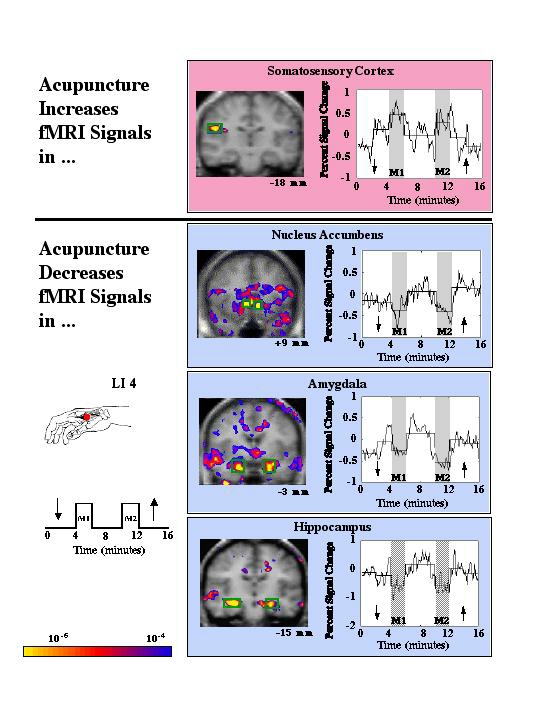
Acupuncture and the Brain

Skeptics always ask about acupuncture's effects on the brain. I once had an friend who wouldn't get acupuncture unless there were F-MRI's showing the exact effect on the brain for every acupuncture point. As my sports coaches used to say, "You can go a lot further than you think you can."

Harvard's F-MRI imaging and report details
the brain's response to a commonly-used
acupuncture point.
Let's go back to the need for proof. F-MRI reports from acupuncture sessions are expensive, and so these studies aren't performed on as many people or the way everyone would like, but they have been informative. Many show that the brain responds ipsilaterally, or on the same side, to the acupuncture point. This is a surprise to researchers who expected acupuncture to affect the body like any other pin-pricking sensation, in which the signal would travel and stimulate the contralateral, or opposite, side of the brain. (The image below is from the Harvard Study in 'ot seven.)

In Chinese Medicine, there is no separate system of nerves, although the brain is recognized as one of six "extraordinary organs," along with marrow, bone, uterus, vessels, and gallbladder. What these "organs" have in common is that they all house or facilitate the movement of a refined substance. The lack of a separate nervous system receiving sensory input and issuing commands to the body leads many acupuncturists to believe that the channels are conceptualizations of nerves and their relationship to all tissues. Still, conventionally accepted explanations of how acupuncture works almost always mention communication between the central and peripheral nervous system.

Friday, August 27, 2010

Beat the Cold/Flu

Texas weather changes at an alarming rate, to the point that we cannot be blamed for leaving for work in a light jacket and coming home wishing for our heavy coat. In Chinese Medicine, we treat those weather patterns as pathogens; they are broad and we can easily see their effects. From a modern medicine viewpoint, drastic weather changes can incapacitate the immune system and allow viral and bacterial pathogens to invade.


Suddenly, you realize that you did not dress warmly enough at lunch, and you feel slightly achy in the afternoon. Maybe there's a tickle in your throat. By the time you drive home, you are beginning to have chills. Your head throbs. You know this cold is coming.

Before you go to bed with that cold, I recommend heading straight to the grocery store for a big ginger root, and some cinnamon if you don't have any.
  1. Chop the ginger root coarsely. Run a tub of hot water and make sure your neck is immersed in the water. Rub the warm ginger pulp over your upper back and neck.
  2. Boil some water with ginger and cinnamon, and strain it for tea. Add some honey, no more than 1 tsp.
Start with this simple solution. If your symptoms do not improve immediately, consider making an appointment with your acupuncturist. Acupuncture works well by rallying the immune system during the early stages the cold or flu.

Tuesday, June 8, 2010

An Acupuncture Testimonial

Growing up, I watched Sleeping Beauty and went to the doctor, so I was terrified of needles. The 80's was big on safety (who uses a spinning wheel anymore?), so everywhere I went, there were warnings about sharp objects, and especially needles. Sharp. Painful. Warning. It usually is painful, too, when someone uses a needle to get something out of us.

I understand when we say that acupuncture is an unexpected and unlikely solution to our physical problems. Ten years ago, I felt that way, driving by acupuncture clinics and imagining God knows what is going on in there. I was also experiencing severe allergies, digestive upset, and I was piling on cumulative stress. My face was so swollen it needed ice some mornings, and I went to the bathroom once a week. A friend of mine convinced me to try acupuncture, and after about 3 years of exposure from a distance, I tried it. Within two months of treatment, my allergies cleared up. I haven't needed to return for that intense weekly treatment of allergies in seven years.

I waited so long to get acupuncture because I had a few misconceptions about it, and about health care in general. For one, I didn't understand that I had power over my own health care. Sometime during the first year of treatment, I realized I had power. I still sit forever in the waiting room like anyone else, but when I receive examination and treatment, I understand that it is always with my permission.

I also didn't see how easy and comfortable an acupuncture treatment could be. An acupuncture needle isn't trying to get anything out of you, or put anything into you. It recognizes that within your body, you have all the tools to right yourself both physically and emotionally. It is an open communication with the subtler aspects of the nervous system. An acupuncturist has been taught to put needles in the most instructive and helpful spots for you.

After this experience, I became inspired to listen to your story and help you change it for the better.

Monday, April 12, 2010

The Tools of an Acupuncturist

Needles

Acupuncturists use solid, single-use, thin needles. If you want to know more about how needles work, check out the label.

Cupping

Cupping is often used to stimulate a larger area than with a needle, and works to break weakened blood vessels and promote stronger re-growth. Although cupping is rarely painful, it produces bruises on the body (usually on the back, shoulders and neck). Mention to your acupuncturist if you want to avoid bruising during treatment.

Tui na

Tuina is a bodywork technique that stimulates acupuncture points and internal organs with special techniques. Often, Tui na is used to help calm and relax patients, and can be used alone or as adjunct therapy to acupuncture. Sometimes bodywork is more painful than acupuncture because the stimulation from massage can be persistent.

Electrical Stimulation of Acupuncture Needles

The sensation produced by electrical stimulation (e-stim) is a gentle pulsating electrical sensation, often used for managing severe pain, regenerating tissue for faster healing, and to restore feeling and movement in patients with numbness or paralysis.

Moxibustion

Moxibustion is burning mugwort above or directly on acupuncture points. Mugwort is used because of it produces a penetrating heat that few substances can match when burned. Moxibustion (or moxa) is used to warm and relax the muscles. Moxa can be used in the clinical setting or for self-care at home.

Monday, March 22, 2010

Acupuncture and Placebo Effect

Although many practitioners believe in the power of the mind to aid healing, acupuncture is not a therapy based on ‘placebo effect.’ While acupuncturists often encourage mental exercise such as meditation during treatment, it is not necessary for the patient to have an understanding (or belief) of the mechanism of each treatment. The effectiveness of a treatment may seem magical and mysterious, but this impression is usually due to the surprise of success!

The Oriental perspective on acupuncture combines ancient knowledge with modern practice. Acupuncture is practiced in all forms of Oriental medicine (chiefly Chinese, Korean, and Japanese). The first medical text on acupuncture is 2500 years old. The balance of yin and yang in the body is the oldest theory, in which all the body’s elements can be compared and balanced with one another. Qi (vital energy) is everywhere in the body, and is a series of processes that acupuncturists manipulate in order to affect deeper areas. The principle of wholism tells us that since everything in the body is connected, we can treat a small area that reflects the entire body (such as the hand or ear). Finally, many theories within acupuncture are based on modern clinical practice. In every treatment, points that have been tested thousands of times in clinical setting will be used again, in a variety of constellations.

Monday, February 22, 2010

Chinese Medicine Overview

In the West, the terms "Chinese Medicine" and "acupuncture" are often used interchangeably. In reality, acupuncture is only one aspect of Chinese Medicine, both unique and exotic. As the primary health care system in China for thousands of years, Chinese Medicine has become complex, comprehensive, and full of variety.

There are five main branches of Chinese Medicine:
  1. acupuncture
  2. herbology
  3. nutritional therapy
  4. manipulative therapy
  5. exercise
I use all five of these aspects because together they help ensure lasting results.

More about Chinese herbs

With a rich history, full materia medica, and treatment complementary to acupuncture, Chinese herbs provide the building blocks to smooth transition in the body. Whether the goal is to detoxify and de-stress or to boost energy, metabolism, or immunity, Chinese herbal prescriptions are deeply effective and balanced just for you. For information about the herbs I carry, check out Evergreen Herbs.