Search for a topic

Showing posts with label Articles. Show all posts

Tuesday, June 12, 2012

Acupuncture Releases Endorphins

Endorphins are released while
running from monsters
Athletes and exercise enthusiasts are well familiar with the function of endorphins. Once an athlete reaches an exhaustion level, they experience a feeling that some have dubbed, “runner's high.” This could apply to any physical exercise. This euphoric, whole-body feeling comes from endorphins, which are released in order to allow the body to endure longer periods of strenuous activity than normal. In the prehistoric human body, endorphins were developed for long periods of flight from large, powerful predators, enabling humans to survive hazardous over-exertion by stopping pain associated with over-extended tissues and organ systems.

Endorphins are released when
eating spicy foods
Pain killers represent the most popular group of drugs on the market. From headaches to knee pain, everyone is looking for a solution to their pain. Multi-million dollar clinics are opening under the title “Pain Management.” While these solutions (namely drugs and surgery) help to manage pain, acupuncture stops it completely. Long-term studies detailing the results of acupuncture treatment for pain showed significant improvement in patients who completed their treatment plan, even years after their last acupuncture treatment. (Here's an example.)

Endorphins are released
in response to pain
Acupuncture is able to stop pain better than most drugs because of the body's natural endorphins. Acupuncture unlocks a dormant quality within the body, which, when activated, operates at a strength ten times any drug on the market. For example, researchers at UNC are using acupuncture instead of spinal injection to increase the effectiveness of a new drug. Unlike more publicized options, acupuncture is safe and causes no side effects.

The effects of acupuncture on pain are immediate. A patient called me in significant pain from a sprained wrist. I quickly applied acupuncture and asked him to rotate his wrist at the end of the treatment. His expression brightened and his eyes became wider as he was able to not only move his wrist without pain, but also with a significantly larger range than when he had first strained it just a few hours earlier. I continued to apply acupuncture and added an herbal compress to increase his circulation and heal the wrist completely, but acupuncture brought him immediate relief from pain that he did not hope to expect.

Monday, September 12, 2011

Nutritional Supplements

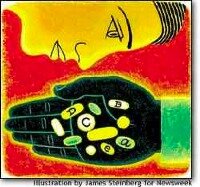
When we've begun to eat right but are still struggling with health problems, we may turn to supplements for help. Unfortunately, many supplement providers cannot tell us the actual effect of their product on our bodies. When we eat Centrum or Flinstones chewables, they have a high "nutrient content," but most of it cannot be absorbed and used by the body, so we just pass it via urination or defecation. Many people taking multivitamins report significant changes in their urine color for this reason. Passing huge amounts of nutrients through our bodies is not proportional to the nutrient benefit our bodies are actually metabolizing from the product.

Vitamin vendors may give information about their product which can be valuable and true, given that we apply it to the vitamin and not the supplement product. They say, "Your body would benefit from additional Vitamin D." I usually nod, smile, and walk away from their pill table and into the free sunshine. (Apply aloe vera gel for added Vitamin E and UV protection. Applying it directly from the plant works best.)

Whole supplements are the most efficient method of integrating nutrients into our bodies. Here are some examples of supplements I use:
  • Floravital is an excellent supplement for regulating anxiety, sleep disturbance, lethargy and more.
  • Emergen-C is an important electrolyte replacement method, which uses much less sugar than Gatorade. (I use bell peppers, fresh herbs, and oranges as a source of Vitamin C.)
  • Chinese herbs are whole food supplements that can be combined to balance the whole body, with emphasis on your specific concerns.
Mangoes are rich in Vitamin A

When the "whole" aspect of food is removed by extracting or synthesizing more intense versions of a useful compound, the nutrient becomes less useful. Toss your supplement pills in favor of more nutrient-rich foods. If you need to adjust your metabolism, the appropriate combination of acupuncture and Chinese Herbs will smooth the root of your digestion.

Tuesday, July 12, 2011

Whole Foods & Our Moods

If you're feeling depressed, I suggest having a banana. If you came here looking for answers and you haven't eaten in the last four hours, please use the time you would finishing this post and dedicate it to a strawberry or something that you find super yummy.

It's hard to think when we're hungry; it's a part of the human condition.We require food to physically relax and without it, we are basket cases. Ever seen your uncle blow up at the staff at a restaurant because of a long wait? He was hungry.

We can pack pills full of all the nutrients in a week's worth of meals, but they cannot replace the food, and we will become hungry. Why ignore the hunger mechanism and give our bodies only part of what they need? Food is bioavailable; we can pack many nutrients into the foods we eat. They are meant to be processed by your stomach and small intestine, and passed on to your liver, where all the impurities are filtered and the vitamins sucked out and plugged into your system where they're needed.

Eating....
  • subdues the hypothalamus (relieving it from having to secrete hunger hormones as well as manage the body's stress from its nutritional deficit)
  • assimilates essential elements in order to relax muscles, potentiate energy and stabilize emotions
  • stimulates the body into releasing powerful feel-good chemicals
 The brain is a great example of an organ that requires a good many exotic substances in order to release and receive its communications with the body. I'm not talking about the "Brain Food" that was marketed in the late 90's; all food is brain food, because the primary substance used by the brain is glucose. Most foods have substantial amounts of glucose, yet we often only provide our bodies with refined sugars, which are more difficult to assimilate than the simple sugars in fruits and vegetables. So how about that banana?

Tuesday, June 28, 2011

Acupuncture and the Brain

Skeptics always ask about acupuncture's effects on the brain. I once had an friend who wouldn't get acupuncture unless there were F-MRI's showing the exact effect on the brain for every acupuncture point. As my sports coaches used to say, "You can go a lot further than you think you can."

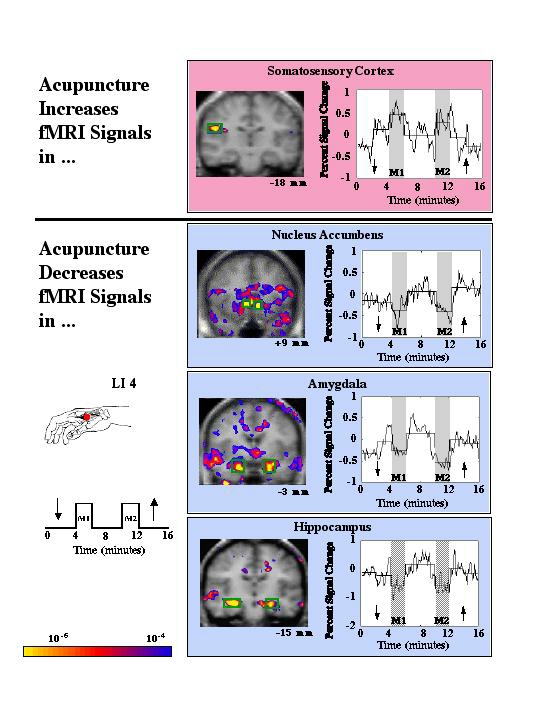
Harvard's F-MRI imaging and report details
the brain's response to a commonly-used
acupuncture point.
Let's go back to the need for proof. F-MRI reports from acupuncture sessions are expensive, and so these studies aren't performed on as many people or the way everyone would like, but they have been informative. Many show that the brain responds ipsilaterally, or on the same side, to the acupuncture point. This is a surprise to researchers who expected acupuncture to affect the body like any other pin-pricking sensation, in which the signal would travel and stimulate the contralateral, or opposite, side of the brain. (The image below is from the Harvard Study in 'ot seven.)

In Chinese Medicine, there is no separate system of nerves, although the brain is recognized as one of six "extraordinary organs," along with marrow, bone, uterus, vessels, and gallbladder. What these "organs" have in common is that they all house or facilitate the movement of a refined substance. The lack of a separate nervous system receiving sensory input and issuing commands to the body leads many acupuncturists to believe that the channels are conceptualizations of nerves and their relationship to all tissues. Still, conventionally accepted explanations of how acupuncture works almost always mention communication between the central and peripheral nervous system.

Wednesday, June 22, 2011

Acupuncture Meridians and Shiva Nata

"...performing such movements sets a series of alternating active and passive fragments of the energy flow. These energy impulses purify energy channels and balance the circulation of energy inside them." - Andrey Lappa, the man who systematized Shiva Nata
I began teaching classes because I want my patients to practice Shiva Nata. We are always working with the meridians of our bodies. These landmark pathways are also known as channels or vessels, and they are the primary means by which acupuncture affects the body.

In acupuncture, we place needles at a location and depth which is indicated to promote the balance of hormones, endorphins, immunoglobulins and circulation. A point's indication depends on three main qualities: its immediate location, the meridian pathway, and its category (a combination of depth and connectivity to other meridians and branches).

The meridian pathway is essential to any acupuncture point's function. The best resource to explore while learning about how Shiva Nata affects the meridians would be to learn the meridian pathways. Instead of seeing meridians as energy channels that float on the surface of the body, we could see them as embedded in all our tissues to the deepest level. Once you are familiar with the pathways of the primary organ systems, you can foster an understanding of how these movements activate and strengthen their relationship.

When we practice, our focus is on twisting, flailing, and ultimately balancing those meridians. We rotate the arm channels on all axes. Shiva Nata powerfully supports this balance because it addresses all of the meridians - as opposed to most of our activities, which focus all our energy into one, two, or a handful of positions and movements. Balance can be achieved because no channel is left unused, unstretched, or unrotated. The meridians are activated either by a relative emphasis on the energetic meridians or the physical structures that they involve.

The path learning Shiva Nata combines all possible movements of all the meridians in a balanced and coordinated way. Horizontal arms 4 is a strong position for the heart and lung channels - meaning there's effort and tension in those systems when it is held. Moving from 4 to 3 horizontal is a rotation that integrates the large intestine and small intestine channels. According to Chinese Medicine, the heart and small intestine, and the lung and large intestine are intricately related to one another, and they work "as a husband and wife." Moving from horizontal 4 to 3 strengthens this relationship, and practicing this movement and its derivations could repair a damaged relationship between organ systems to restore balance.

I am not so far as to diagnose a complex syndrome based on level-related struggles or prescribe certain movements to harmonize dissonant organ system patterns. We have barely begun.

Sunday, December 12, 2010

Body Language and Acupuncture

Anyone can be treated by Chinese medicine. We have a set of tools, some for treatment, some for diagnosis, for the practitioner and patient to choose from.

For diagnosis, your tongue and pulse will always be included. Sometimes I will ask more questions than others, or I will fixate on a symptom that appears significant.

Treatment can include: acupuncture, bodywork, and herbs. Acupuncture includes: needles, needle-free acupressure, gua sha, cupping, placement of seeds or magnets, or electrical stimulation. Herbs can be used in a variety of ways. There are internal pills and teas, as well as external patches, washes, and salves.

These tools work with anyone, but not every acupuncture clinic is packed with people making this discovery. Why not?

I'd like to share with you some important truths about your body and acupuncture treatment.
  1. Your personal experience of what's happening in your body is the bottom line. It's the single most important part of your health.
  2. Your body speaks to you and wants you to share in the experience, even if it is troubling.
  3. You are the one who heals your body. Science, systems, and procedures only make room for your body to heal itself. Give your self and your body the credit they deserve!
I am on a quest to become more in touch with my body, so that I can speak its language and give it what it needs. I invite you to join me in a daily practice of asking our bodies what they need. We receive any answer with acceptance, playing with it and turning it around.

If you get regular acupuncture, this question really helps with the acupuncture's effectiveness. If you have not yet gotten acupuncture, it will help prepare you and your body for the experience.

Monday, November 15, 2010

Easy Tips for a Healthy Diet

When cooking I use whole ingredients, and recommend fresh when possible. My highest recommendation for food shopping is using local organic and sustainable delivery programs, like Greenling's Local Produce Box.
The grocery store presents a working alternative to having fresh produce delivered to your door. You may emerge victorious even from the grocery store if you use these simple guidelines:
  1. Meal plans and grocery lists are essential, especially if you're on a budget. Depending on how much structure you need, sometimes a simple grocery list will suffice, but I recommend making a meal plan for at least two weeks. You can bargain and compromise with your meal plan, but after two weeks, you may start to find it comforting or see enough improvement to operate without it. For patients, customized meal planning is included in sessions with me.
  2. Buy foods that make your mouth water. The quest for resonant and inspiring experiences to promote well-being includes flavors. Purchase ingredients that you want to be a part of, because they will become a part of you.
  3. Be generous. Reduce waste while meeting your needs, without limiting ingredient portions. If you have a lot of waste or hate leftovers, split the ingredients to make varied, smaller meals. By maintaining your food supply, you can begin to understand your habits and make important changes, instead of swinging on the diet pendulum.
  4. Try my recipes, taken from a variety of cookbook resources, as well as my own taste. There's Summer Breakfast Tacos, Healthy Mac & Cheese, Pasta Primavera, and more!
  5. Acupuncture regulates the hormones ghrelin and leptin, balancing both your metabolism and your cravings. Regular acupuncture sessions provide a blueprint for you to lose weight faster and more easily with your diet and exercise program.
Give over to your feral nature at the grocery store! Become wild, and gather your ingredients as if you were about to cast a spell of the utmost importance! After all, eating is a personal priority.

Monday, September 6, 2010

What to Expect When You Quit Smoking

"Quitting smoking is the easiest thing I've ever done. I've successfully quit smoking over 100 times." - Mark Twain
I dislike the term 'quitting' for such an engaging process. Smoking isn't a job or a goal, and any person wanting to be a quitter is about as ridiculous as Harry Potter wanting to suck. You quit a job. You quit a sport. You quit when you want to give up. With smoking, you let go. It's liberating.

One day you decide to let go. Hooray! No more empty pockets, smelly fingers, rancid tongues, achy teeth, headaches... notice I didn't even get to cough yet. Or the amount of time spent smoking only to feel hassled and tardy.

Weeks after liberation you may have dreams about smoking, and you wake up yelling, 'No! Don't have that cigarette!' Through these signs, your body and your subconscious ask for your support because you have entered a new stage of quitting. Speaking of stages, I've outlined the main 5 phases of liberation. These may change order or skip for some people, but it helps to know what to expect.
  1. Withdrawal:  Withdrawal is where you do the hard work of kicking the habit, with the faith that the feeling has to end - and it will. In the meantime: acupuncture, herbs, and your willpower can see you through the first 7-14 days. (Frequent detox acupuncture treatments during this time have eased the withdrawal symptoms of many of my patients. Find out about the NADA protocol and its benefits.)
  2. Rush:  After the hard work has been done, it's easy to feel cocky. And perfectly okay! Just remember that you're not invincible. Be prepared to rest when your energy levels start to normalize.
  3. Plateau:  It's easy to get bored and complacent here. Celebrate your victory now that you have put some miles on quitting. How can you celebrate in a way that keeps you in touch with your body and how it has transformed - something just for you? In fact, this is the perfect time for a follow-up acupuncture treatment.
  4. Dip:  Somewhere along the line, life happens. Beware the holidays, stressful projects at work, and other seasonal activities for the first year. Plan accordingly, and take care of yourself. By now you are receiving acupuncture on an "as-needed" basis, so don't forget to check in when you're nearing a dip!
  5. Forget:  You know you're finally over it when you forget about smoking for months and then remember that hey, you used to smoke. No more crazy dreams, no more waking up at 5 am, no more morning cough. Not only are the yucky things missing, but you also have your own special reason for staying smoke free. Money in your pocket? More time to spare? Better sleep? Look around you and appreciate everything you have now because you let go of the habit.

In all of this, there's one or two things that you'll absolutely love about "quitting" - it's your job to find them and hold on to them. The first two weeks are the groundwork for the next few months, which depend on your stress levels. If you drink or use other substances, you are likely to make unbalanced decisions at a bar or party. Only you know when it is time to return to those environments with confidence that you can remain smoke-free.

Thursday, February 25, 2010

Appropriate Acupuncture

I saw that acupuncture was mentioned in a local news broadcast about allergies. Based on the article and comments, I am inspired to continue educating the public; I feel that is my task as a health care professional.

Acupuncture produces both specific and general beneficial, detectable effects on the body. Not only is it extremely effective when combined with whole herbs and/or pharmaceuticals (because who said doing acupuncture meant giving up your current means of relief?), it also produces changes in the brain that can be detected with fMRI - here's a study done at NIH.

This study provides information on how acupuncture regulates pain, but how about allergies? First we can think of the mechanisms of allergy drugs, like antihistamines, steroids, etc. They inhibit immune receptors that are overactive during an allergy attack. However, this is a non-specific effect, meaning that it is likely to leave the immune system vulnerable to actual pathogens or to cause side-effects.

Ask your doctor how your body maintains the proper amount of histamine receptors, and he or she will probably tell you a variety of things: genetics, metabolism, endocrine activity... But the truth is that this way of looking at medicine can only examine the infinite detail as it is categorized, further separating the right arm from the left arm. This article from Time in 1992 reveals that both our approach to education and our infatuation with neo-technology have led medical care into a fragmented state that further distances the public from seeking help without significant trauma to both mental and financial (and sometimes even physical) states.

Acupuncturists are provided with extensive medical training on assessment, pediatrics, and most importantly, referral. Physicians are tired of doling out drugs for routine family issues; they want to be where they're needed. This works perfectly with acupuncture, which can happily manage fibromyalgia, IBS, and depression, but certainly doesn't set broken bones or manage physical obstructions.

Many younger physicians are somewhat familiar with and open to acupuncture, as it is included in their complementary alternative medicine (CAM) module of study. More allopathic doctors have a basic understanding of Chinese medicine principles as well as familiarity with the extent of the acupuncturist's biomedical education. (here's the module where I graduated)

Tuesday, July 8, 2008

The Bet (A Medical Parable)

An acupuncturist and a Western doctor walked into a bar. They bought drinks for one another; each bragged constantly that he could treat any disease, however rare. While they were having their drinks, the bartender disclosed to them that his identical twin daughters were very ill. Furthermore, the daughters seemed to be suffering from the same mysterious illness. The bartender said that their temperatures, symptoms, and attitudes changed at the exact same time. Both physicians became very interested in the case, and they decided that each would treat one of the daughters. In good humor, they placed a bet on who would be able to cure the illness.

"I bet I can cure it the fastest," said the Western doctor.

"I bet I can cure it so that it will not return," said the acupuncturist. Each gave the bartender their share of the bet money, so he could return it to the winner.

The physicians followed the bartender to a loft over the bar, where his daughters were sleeping. The twins were so identical that they were even breathing in time with one another. Their skin was very pale except in their cheeks, which were slightly flushed. They seemed to be breathing more quickly and shallowly than normal, but the bartender assured them that the girls had not experienced any cough.

He said that a few days ago, his daughters arrived home from a party feeling so fatigued that they could not speak. For two days, they could barely leave the house. They did not want to eat, but at night, they had difficulty sleeping. They had not spoken a word since they arrived home from the party, so the bartender was not sure what had happened. He explained that his daughters were normally very talkative and active; they often helped him in his work at the bar. Their mother had died eight years before from an unknown illness. The bartender, becoming very sad, explained that he was unable to raise enough money for his wife's treatment.

After the bartender finished his story, the two healers explained their plans to him. The acupuncturist marked his sleeping patient's right hand with a red dot, and the Western doctor placed a red dot on his patient's left hand. The healers knew that they were smart enough to remember their patients this way.

"I believe your daughters caught a disease when they went to the party," said the Western doctor. "I will search for this disease as carefully as I can. Once I find it, I can find a way to eliminate it." The Western doctor performed a detailed examination on one of the daughters. Her respiration rate and pulse were rapid, supporting his suspicions about the disease. "See," he told the acupuncturist, "You can cure any disease if you can look closely enough to find it." With that, he took a vial of the girl's blood and left to analyze it.

The acupuncturist did not leave the loft for many hours. First, he felt the other daughter's pulse. It seemed soft, but rapid, and very slippery. It was even soggy in the first position. Gently, he woke her and asked her to stick out her tongue. At first sight it seemed fairly normal with a slightly red tip. As he looked closer, he could see that the tongue coating was slightly greasy. Since his patient was awake, he asked her a series of questions. She could only shake her head or nod, but they were able to communicate. The acupuncturist discovered that she felt nauseated, slightly bloated, and hot. She was having loose, foul-smelling stools, and she felt very fatigued. While she had some abdominal cramping, she had very little pain otherwise.

Turning to the bartender, the acupuncturist explained his perspective. "Your daughters have indeed caught a disease, but I believe it was from something they ate, instead of from a person. It will take me a few days to remove this illness from one daughter, and then we will see how my friend fares with the other."

The acupuncturist performed a series of treatments on the bartender's daughter. After he placed the first needle (LU 6), she began to speak, very slowly and hesitantly. "I…had…to…find…" She fell asleep before she could say more. The acupuncturist placed the rest of the needles while the girl was still sleeping, and she did not move for some time. Once the treatment was finished, he gave her an herbal tea to sip constantly. She took a sip, and then cringed. "It… tastes… terrible…" she managed. Her father broke in, "At least you're speaking again!" He kissed her on the forehead, and she quietly continued sipping her tea.

For three days the acupuncturist treated one daughter, while the other one lie still in her bed. The acupuncturist's patient continued to gradually improve, and he gave her several treatments per day, while still managing to eat, sleep, and see a few other patients. As she improved, he made adjustments to her herbal prescription.

Her twin's condition did not worsen, as her father reported with relief to the Western doctor, who arrived on the third day looking both tired and winded. He had tested his patient's blood and had finally worked out a beneficial cure. He gave his patient an injection, and she awoke within six hours. She still felt groggy and tired, and was unable to speak for a day or so, but the Western doctor assured the bartender that he was confident in his treatment, and left to get some much-needed sleep.

On the seventh day, the physicians met in the bar once again to discuss the outcome of their bet. They asked the bartender to show them up to see their patients. When they arrived in the loft, the daughters were playing a card game. The bartender said, "Now, about your bet. I will give the money to whichever one of you can identify his patient." The physicians did not expect the bartender's challenge; they took the daughters' hands, and found that the bartender had marked both of their hands with red dots. The Western doctor did a physical examination, while the acupuncturist used all of his clinical skills to tell the difference; both could find no difference in their improvement, or even enough to tell them apart.

The bartender laughed. "You are both very competitive and very competent at your practice. Your patients come into my bar and talk to me, and they all want different things from you. Often, your treatments are successful – only occasionally do they fail. I must be honest. My daughters are very special; even I do not know how to tell them apart. If you choose to ask, they will tell you which one you treated."

One of the girls looked up from her hand of cards to the acupuncturist. "I'm so thankful to you for treating me," she said. "I feel like I suffered a lot through the treatment. I had to drink that disgusting tea, and I struggled because I was awake and aware for most of my illness. However, I feel that through my hardship, I learned much about myself. I was also the first to speak again, and I thank you for that."

The other girl turned to the Western doctor. "And it was you who helped me. While I was sleeping, you discovered the cure to my disease, as though you came from a dream. I know that you will tell others how to cure this disease in other areas of the world. I slept for so long that I wasn't sure when I would awaken. My sister was awake before me, but once I awoke, I recovered faster. I can't thank you enough."

The physicians grinned at each other. To reward his cleverness, they allowed the bartender to pocket the bet money, and he vowed to build a proper memorial for his wife. As they exited the bar, the Western doctor jokingly asked the acupuncturist, "So, who do you think won?" The acupuncturist shrugged and said, "I think we both did."

*I wrote this passage as an essay assigned to describe the differences between diagnosis and treatment in Chinese and Bio medicine. I don't think this is what Dr. Wu was expecting, but he seemed pleased.
**I find it ironic that, last weekend, an epic bet was placed on Wimbledon that resulted in Renae being dubbed 'high priestess of tennis.'